Di completed a B. Fine Arts degree at Rhodes University in the early 70’s, majoring in painting. Although her training was in painting, she is passionate about printmaking, including Intaglio etching, linocut and reduction woodcut. Di has participated in many annual and group exhibitions and has been involved in the bi-annual Open Studios in Prince Albert since its inception. A highlight was the 2018 Stellenbosch University Centenary Celebration with a series of commissioned paintings of historical buildings associated with the Faculty of AgriSciences. Di also took part in the Stellenbosch Woordfees 2017 exhibition called “See the Forest for the Trees”. Di has taken numerous residencies at the Cité Internationale des Arts in Paris and exhibited work at the Lessedra International Print Exhibition in Sophia in Bulgaria. She has exhibited at the KKNK and had several solo exhibitions with Cape Gallery and Prince Albert Gallery amongst others. Di has illustrated several books including technical and scientific manuscripts.
Website: dfjohnson-ackerman.co.za
Facebook: Diane Johnson Ackerman
Instagram: dijohnsonackermanart
R13 600
Acrylic on canvas on board
420 × 310mm
To buy this artwork: Contact René Scribante at rene@scribante.com or 083 627 6757
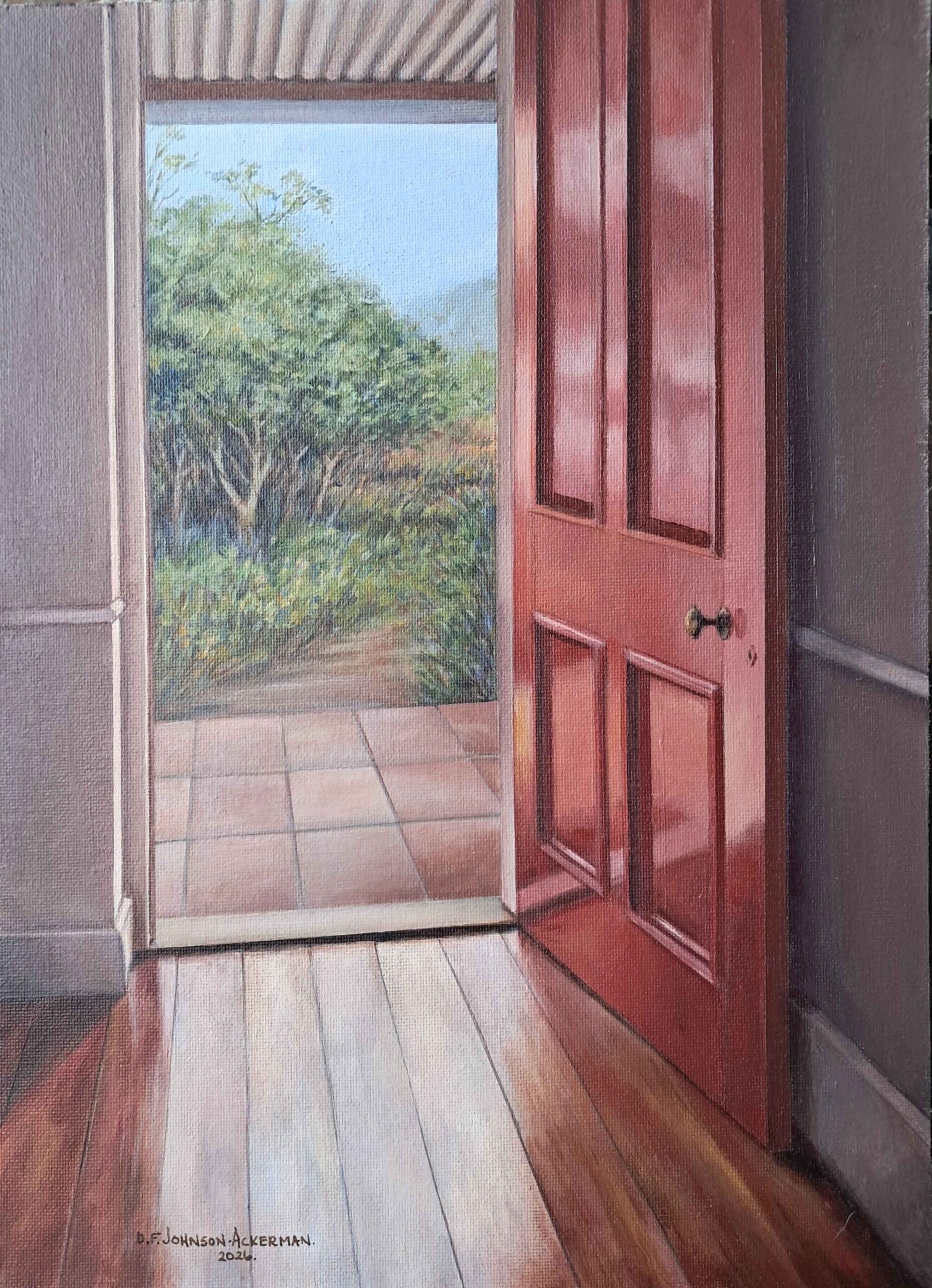
The Red Door explores the threshold between interior and exterior space, inviting contemplation of transition, possibility, and movement. Viewed from inside, the composition frames an open red door leading onto a tiled veranda, beyond which trees and a pathway recede into the distance. The doorway becomes both a physical and symbolic passage, drawing the viewer toward the landscape beyond.
The changing light plays a central role in the work. Reflections on the patinated surface of the red door capture the glow from outside, while the wooden floorboards inside echo this light, creating a visual connection between the two spaces. These reflections blur the boundary between inside and out, suggesting continuity rather than separation.
The painting encourages the viewer to imagine stepping through the doorway, while the directional lines of the floorboards create an equally compelling invitation into the scene. Through colour, light, and perspective, The Red Door becomes a meditation on invitation, curiosity, and the quiet promise of journeys yet to be undertaken.